
A tax-aware income story for the Clough Global closed-end fund family
For investors seeking monthly income, the Clough Global closed-end funds offer a differentiated distribution story. The funds combine attractive managed distributions, 2026 distribution increases, recent Return of Capital (ROC) classifications, and meaningful capital loss carryforwards that may help support potentially tax-efficient distribution outcomes over time.
Current Distribution Snapshot
| Fund | Ticker | Current Monthly Distribution | 2025 Monthly Distribution | Increase vs Prior Year | Capital Loss Carryforward* |
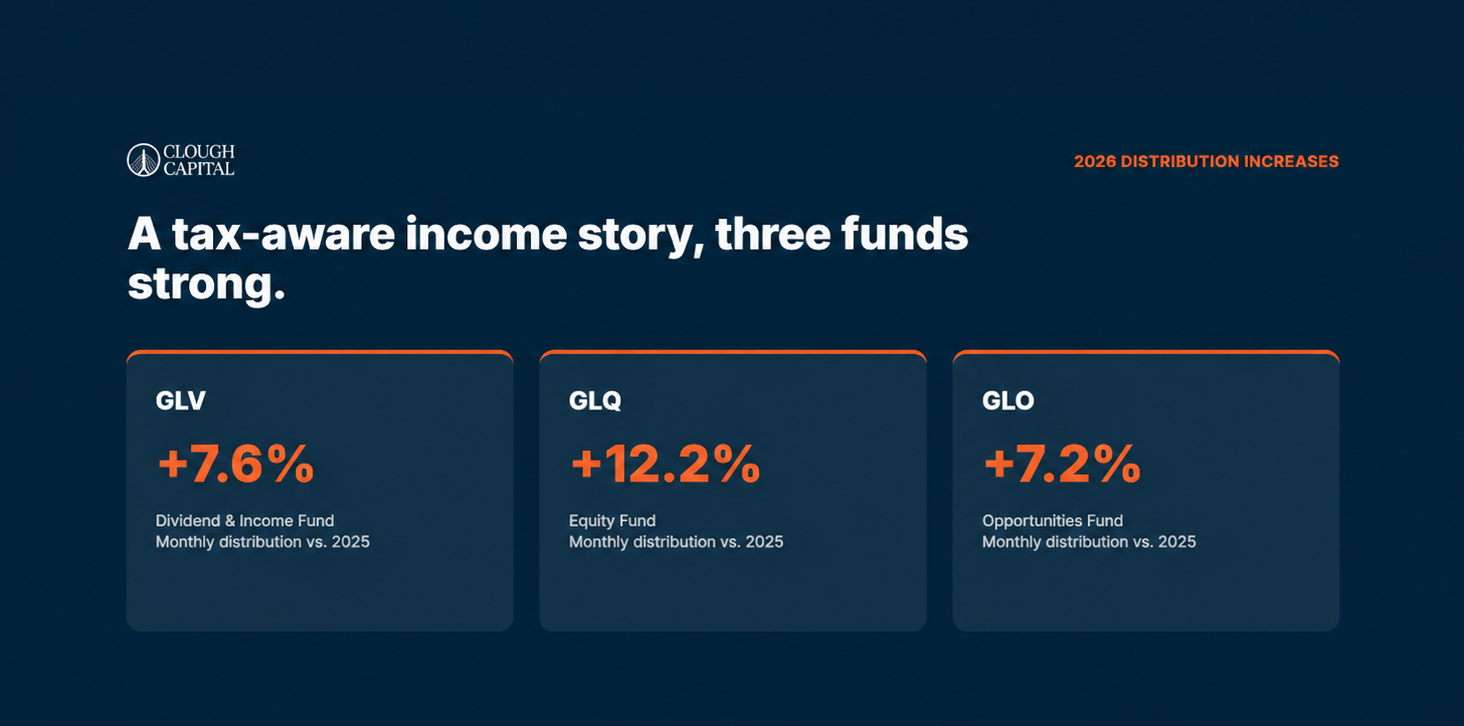
| Clough Global Dividend and Income Fund | GLV | $0.0566/share | $0.0526/share | +7.60% | ~$22.6 million |
| Clough Global Equity Fund | GLQ | $0.0729/share | $0.0650/share | +12.20% | ~$52.1 million |
| Clough Global Opportunities Fund | GLO | $0.0537/share | $0.0501/share | +7.20% | ~$112.7 million |
* Capital loss carryforwards are as reported in the funds’ October 31, 2025 Annual Report.
The Opportunity: Higher Monthly Cash Flow with Potential Tax Efficiency
Closed-end fund investors often focus on headline yield, but after-tax income can be just as important. The Clough Global funds’ 2026 distribution increases add to an already compelling income profile. Recent distribution estimates have included significant ROC components, which may be valuable for taxable investors because ROC is generally not immediately taxable. Instead, it typically reduces an investor’s cost basis, potentially deferring taxes until shares are sold.
| Potential Benefit | Investor Impact |
| Distribution growth | 2026 monthly distributions increased by 7.6% for GLV, 12.2% for GLQ, and 7.2% for GLO versus prior-year levels. |
| Tax deferral | ROC is generally not taxable in the year received, though it reduces cost basis. |
| Improved after-tax cash flow | Investors may retain more of each monthly distribution in taxable accounts. |
| Use of tax assets | Capital loss carryforwards may be used to offset future realized gains, subject to portfolio activity and tax rules. |
Why Capital Loss Carryforwards Matter
A capital loss carryforward can be an important tax asset for a closed-end fund. When a fund has accumulated realized capital losses, those losses may be used to offset future realized capital gains. This can reduce the amount of taxable capital gains the fund is required to distribute to shareholders, depending on future portfolio activity and applicable tax rules.
For the Clough Global funds, the carryforwards add important context to current ROC-heavy distributions. The key question for investors is not simply whether a distribution includes ROC, but whether the fund’s long-term NAV performance and total return support the distribution over time.
| Constructive ROC | Destructive ROC |
| May arise from tax attributes, unrealized gains, accounting differences, or strategy-related timing. Can be a potentially tax-efficient method to deliver cash flow. | May occur when distributions are not supported by long-term portfolio returns and can erode NAV over time. |
Key Takeaway
- Attractive monthly distributions with 2026 increases across GLV, GLQ, and GLO.
- Recent ROC-heavy classifications may provide tax deferral benefits for taxable investors.
- Significant capital loss carryforwards may help offset future realized gains.
- A total return investment approach designed to support both income and capital appreciation.
Important Disclosures
The amounts and sources of distributions are estimates and are not provided for tax reporting purposes. Final tax character will be determined after year-end and reported on Form 1099-DIV. Return of Capital distributions generally reduce an investor’s cost basis and may result in a higher capital gain or lower capital loss when shares are sold. The use of capital loss carryforwards depends on future portfolio activity and applicable tax rules, and there is no guarantee that such carryforwards will produce favorable tax outcomes. Closed-end funds involve risk, including possible loss of principal, and distributions are not guaranteed. Investors should consult their financial and tax advisors regarding their individual circumstances. This material is for informational purposes only and does not constitute investment, legal, accounting, or tax advice, nor should it be considered a recommendation to buy, sell, or hold any security. Investors should consult their financial professional and tax advisor regarding their individual circumstances before investing.
Closed-end funds involve risk, including the possible loss of principal. Shares of closed-end funds may trade at a premium or discount to net asset value (“NAV”), and such premiums or discounts may widen or narrow over time. Closed-end fund market prices may be more volatile than the value of the underlying portfolio holdings. There can be no assurance that any fund will achieve its investment objective.
Distributions are not guaranteed and may be increased, decreased, suspended, or discontinued at any time. A fund’s distribution rate should not be viewed as a measure of investment performance, yield, or total return. Distribution rates may include sources other than net investment income, including realized capital gains and return of capital. A return of capital distribution does not necessarily reflect a fund’s investment performance and should not be confused with yield or income.
The amounts and sources of distributions referenced herein are estimates and are not being provided for tax reporting purposes. Final tax character will be determined after the end of each calendar year and reported to shareholders on Form 1099-DIV. Actual tax treatment may differ materially from estimated distribution classifications during the year.
Return of Capital (“ROC”) distributions generally are not taxable in the year received to the extent they do not exceed an investor’s tax basis in fund shares. Instead, ROC generally reduces an investor’s cost basis. A lower cost basis may result in a higher capital gain or lower capital loss when fund shares are sold. Once an investor’s cost basis has been reduced to zero, additional ROC distributions may be taxable as capital gains. Investors should consult a qualified tax advisor regarding the impact of ROC distributions on their individual tax situation.
Capital loss carryforwards may be used by a fund to offset future realized capital gains, subject to applicable tax rules, portfolio activity, and regulatory requirements. There is no guarantee that a fund will realize capital gains in the future, that capital loss carryforwards will be utilized, or that such carryforwards will produce favorable tax outcomes for shareholders. Capital loss carryforwards do not eliminate investment risk and do not ensure future distributions will be tax-advantaged.
The use of the terms “tax-efficient,” “tax-deferred,” or similar language refers only to the potential tax treatment of certain distributions and does not imply that an investment is tax-free or appropriate for all investors. Tax laws and regulations are subject to change, and changes in tax law may affect the treatment of fund distributions.
Past performance is not indicative of future results. Any reference to prior-year distributions, distribution increases, capital loss carryforwards, or prior distribution classifications should not be interpreted as an indication of future distribution levels, tax treatment, fund performance, or shareholder return.
The Clough Global closed-end funds may invest in equity securities, fixed income securities, foreign securities, derivatives, and other instruments that involve risk. Risks may include, but are not limited to, market risk, equity securities risk, foreign investment risk, currency risk, interest rate risk, credit risk, leverage risk, derivatives risk, liquidity risk, sector risk, and management risk. Use of leverage, if applicable, may magnify gains and losses and increase volatility.
The discussion of “constructive” and “destructive” Return of Capital is for educational purposes only. There is no standardized regulatory definition of constructive or destructive ROC. Investors should evaluate ROC in the context of a fund’s NAV performance, total return, portfolio strategy, distribution policy, and tax attributes.
This material is not intended to predict or project future performance, distributions, tax treatment, or investment results. Statements regarding potential benefits of ROC, capital loss carryforwards, or managed distributions are hypothetical in nature and may not occur.
Definitions
Closed-End Fund (“CEF”)
A closed-end fund is a registered investment company that generally issues a fixed number of shares that trade on an exchange. Shares may trade at prices above or below the fund’s net asset value.
Net Asset Value (“NAV”)
NAV represents the value of a fund’s assets minus liabilities, divided by the number of shares outstanding. A closed-end fund’s market price may differ from its NAV.
Market Price
The price at which a closed-end fund’s shares trade on an exchange. Market price is determined by supply and demand and may be above or below NAV.
Premium / Discount
A fund trades at a premium when its market price is above NAV and at a discount when its market price is below NAV.
Distribution
A payment made by a fund to shareholders. Distributions may consist of net investment income, realized capital gains, return of capital, or a combination of these sources.
Managed Distribution Policy
A policy under which a fund seeks to make regular distributions to shareholders, often at a stated rate or based on a formula. A managed distribution policy does not guarantee distributions and may result in payments that include return of capital.
Return of Capital (“ROC”)
A distribution, or portion of a distribution, that is treated as a return of an investor’s capital for tax purposes. ROC generally reduces cost basis and may defer taxes until fund shares are sold.
Constructive Return of Capital
An informal term sometimes used to describe ROC that may result from tax attributes, unrealized gains, timing differences, or other factors and may be consistent with a fund’s total return strategy. This is not a standardized regulatory term.
Destructive Return of Capital
An informal term sometimes used to describe ROC that may occur when a fund’s distributions exceed long-term portfolio returns and may contribute to NAV erosion over time. This is not a standardized regulatory term.
Capital Loss Carryforward
A tax attribute that may allow a fund to use realized capital losses from prior periods to offset future realized capital gains, subject to applicable tax rules.
Cost Basis
Generally, the amount an investor has invested in a security, adjusted for items such as reinvested distributions, return of capital distributions, and certain tax events. Cost basis is used to calculate gain or loss when shares are sold.
Form 1099-DIV
A tax form used to report dividends and distributions paid to shareholders, including the final tax character of fund distributions.
Total Return
A measure of investment performance that reflects both price changes and distributions over a specified period, assuming distributions are reinvested unless otherwise stated.
Sources: Clough Capital / Access Newswire Q1 2026 distribution announcements for GLO, GLV, and GLQ; Clough Global Funds Annual Report dated October 31, 2025.